
Setting up a factory in Malaysia involves navigating multiple regulatory, licensing and certification requirements.
DagangHalal Consultancy helps foreign companies build a clear, practical pathway for establishing their manufacturing operations in Malaysia.
Malaysia offers an attractive location for manufacturers looking to establish a production base in Southeast Asia.
However, entering a new market can involve requirements at federal, state and local levels, together with industry-specific regulations and certification requirements.
Manufacturing approvals, investment matters, immigration, customs and other national-level regulatory requirements.
Factory location, land, development and other requirements may vary depending on the state and proposed site.
Business premises licensing, signage approval and other local council requirements may apply depending on your location and activities.
Halal, food safety, quality management, product registration and other sector-specific requirements.
The challenge is knowing which requirements apply to your specific factory, and when they need to be addressed.
Your exact requirements depend on your industry, products, manufacturing activities, investment structure, factory location and applicable regulations.
A typical factory setup may involve:
Establish the appropriate Malaysian business presence and understand corporate requirements.
Determine whether your manufacturing operation requires a Manufacturing Licence or applicable exemption.
Assess your proposed factory location, premises and applicable development, building and operational requirements.
Identify applicable business premises, operating, signage and other local council requirements.
Assess product-specific registrations, licences, standards and regulatory requirements.
Plan Halal compliance and certification where applicable to your products and target markets.
Implement applicable systems such as GMP, HACCP, ISO 22000, FSSC 22000 and MeSTI.
Plan requirements relating to machinery, equipment, raw materials, customs and international trade.
Not sure which requirements apply to your business?
One project. One coordinated compliance pathway.
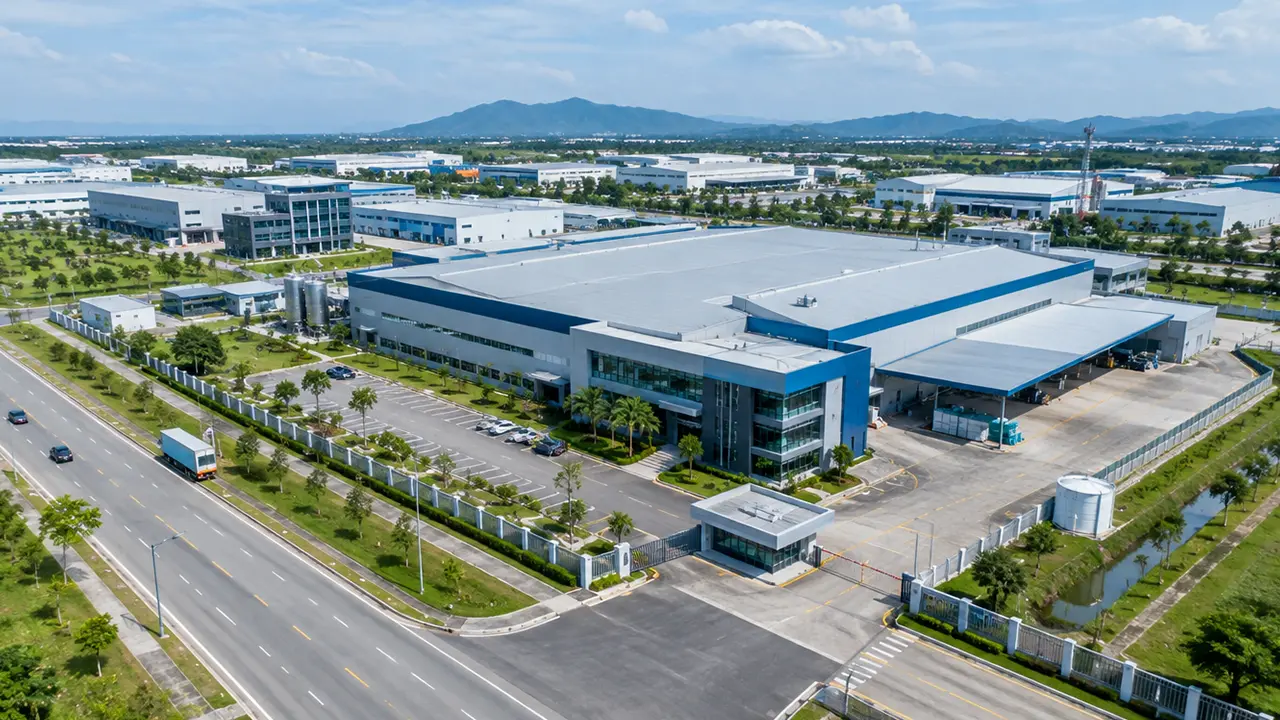
Your factory’s location can determine which local authority you need to deal with and which local requirements may apply.
Choosing a factory is not simply about finding a suitable industrial property. Depending on the factory location, business activity and premises, companies may need to address requirements imposed by the relevant local authority (Pihak Berkuasa Tempatan / PBT).
Not every factory will require every licence or approval. Requirements vary according to the local authority, location, premises, business activity and applicable regulations.
Foreign investors may be familiar with national-level company registration and manufacturing requirements, but local authority requirements can be less straightforward.
Malaysia has different local authorities covering different areas, and their licensing procedures, application requirements and supporting documents may vary.
Malaysia has different local authorities covering different areas. The relevant authority depends on where your factory is located.
The main categories include:
The Department of Local Government (JKT) currently lists 151 local authorities (Pihak Berkuasa Tempatan / PBT) across Malaysia, comprising city councils/halls, municipal councils and district councils.
Official reference: Local Government Department (JKT), Ministry of Housing and Local Government Malaysia.
From initial assessment to operational readiness, we help you navigate the key requirements involved in setting up your factory in Malaysia.
We help foreign investors understand the available business establishment options and coordinate the relevant registration and professional support.
Support may include:
We help assess whether your manufacturing operation may require a Manufacturing Licence or applicable exemption and identify the relevant regulatory pathway.
Support may include:
We help identify the relevant local authority and assess applicable requirements for your selected or proposed factory premises.
Support may include:
We help identify compliance considerations that may affect your proposed factory site and operations.
Areas may include:
For manufacturers targeting the Malaysian Halal market or international Muslim markets, Halal compliance can be an important part of the factory setup process.
Support may include:
Depending on your industry and products, your factory may need or benefit from recognised management systems and food safety certifications.
Our consultancy services include:
Foreign manufacturers may need overseas management, engineers, technical specialists or trainers during factory establishment and operation.
We help you understand the relevant manpower and expatriate requirements and guide you through the applicable process.
We help identify considerations relating to importing machinery, production equipment, spare parts and raw materials.
Areas may include:
A local consultancy partner for your Malaysia expansion.
Understand Malaysia's regulatory, certification and local authority environment with professional local guidance.
Connect business setup, factory, local authority, manufacturing, certification, manpower and import/export requirements into one roadmap.
Identify potential requirements early so compliance can be considered before costly changes become necessary.
We consider your industry, products, manufacturing process, target market, factory location and business objectives.
Your factory is unique. Your compliance pathway should be too.
Supporting foreign companies establishing manufacturing operations in Malaysia.
Establishing their first Malaysian manufacturing operation.
Adding Malaysia as a new production or regional manufacturing base.
Looking for Halal, food safety and manufacturing certification support.
Preparing manufacturing facilities and products for Malaysian and international markets.
Developing quality and compliance systems for specialised manufacturing operations.
Establishing production facilities for domestic or export markets.
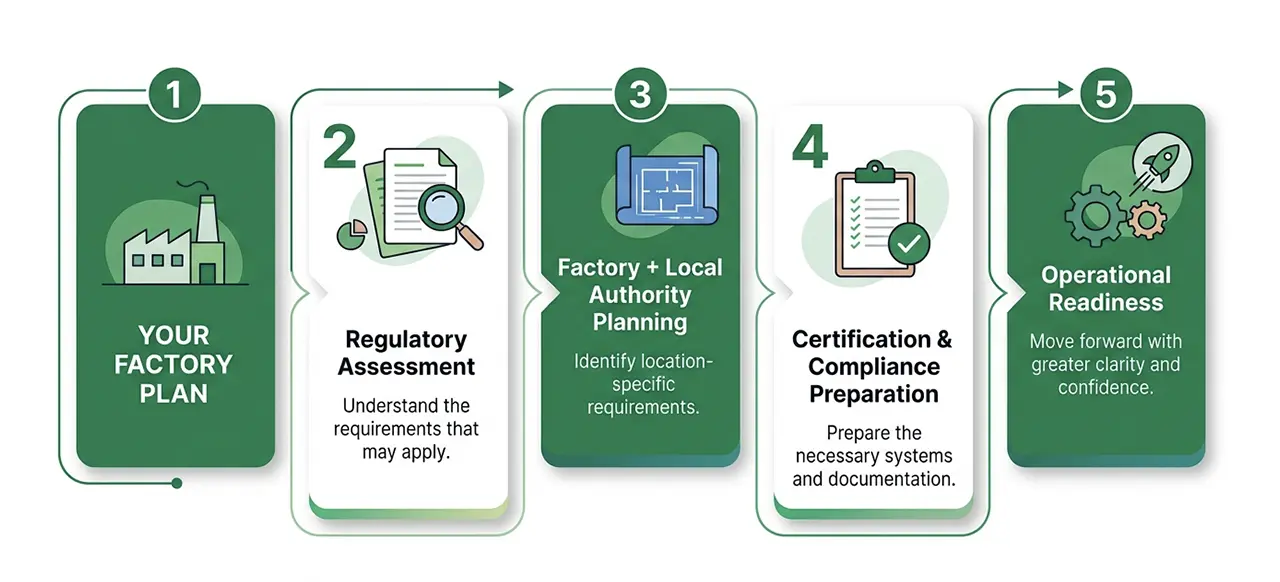
A simple four-step approach to help you move from planning to implementation.
Setting up a factory in a new country can feel complicated when requirements are spread across different authorities and regulatory areas.
Our role is to help you bring these requirements together into a clearer, more manageable setup pathway.
Plan your compliance early. Reduce avoidable uncertainty. Build your Malaysian operation with the right local guidance.
Yes. Malaysia welcomes foreign investment in the manufacturing sector and generally permits 100% foreign equity ownership in new manufacturing projects, subject to applicable policies and sector-specific requirements.
Requirements vary according to the project, but may include business registration, manufacturing approval, factory and premises requirements, local authority requirements, product compliance, industry-specific licences, certification, manpower requirements and import/export procedures.
It depends on your manufacturing operation. Manufacturing companies meeting the applicable shareholders' funds or employee thresholds generally need to apply for a Manufacturing Licence, subject to applicable exemptions.
Local authority requirements depend on the factory location, business activity, premises and applicable local regulations. Depending on the circumstances, a business premises, trade or industrial licence may be applicable.
Signage and advertising requirements vary between local authorities and according to the type, size, location and content of the signage.
Where applicable, the relevant approval or advertising licence should be addressed with the local authority responsible for the factory premises.
The responsible local authority depends on the exact location of your factory.
Malaysia has different local authorities across its states and federal territories, including city councils/halls, municipal councils and district councils.
You can refer to the official Department of Local Government directory to identify the relevant local authority.
Not every factory requires Halal certification. The requirement depends on your products, activities and target markets. However, Halal certification can be highly important for companies targeting Malaysia's Halal market and other Muslim markets.
This depends on the industry and products. For food-related manufacturing, possible certifications include MeSTI, GMP, HACCP, ISO 22000 and FSSC 22000, while Halal certification may also be relevant.
Foreign professionals may work in Malaysia subject to applicable employment and immigration requirements. Relevant manufacturing-sector expatriate applications under MIDA's purview are handled through the applicable MIDA process.
Yes. Early planning is one of the best times to engage a consultant. Understanding regulatory, factory, local authority and certification requirements before selecting a factory, purchasing equipment or designing production processes can help identify potential compliance issues earlier.
You don’t need to understand every Malaysian licence, certification and regulatory requirement before contacting us.
That’s what the consultation is for.
Whether you are still evaluating Malaysia, searching for a factory location, preparing your business registration or already planning production, we can help you identify the key requirements that may apply to your project.
